Rest Advantage Realities: Examining How Back-to-Back Games Skew NBA Predictions and Totals
Taylor Simon · May 17, 2026
Rest Advantage Realities: Examining How Back-to-Back Games Skew NBA Predictions and Totals
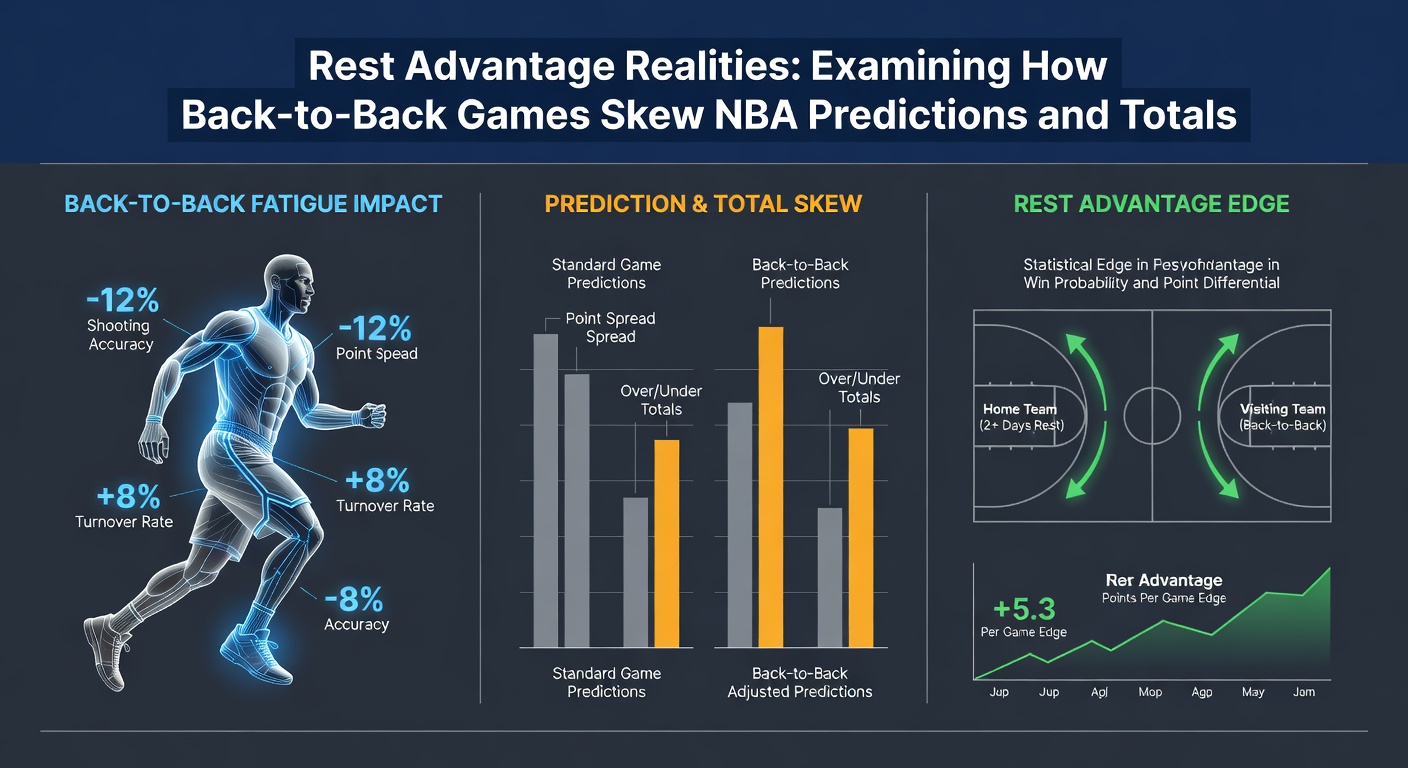
Back-to-back games remain a staple of the NBA regular season schedule because teams play 82 contests across roughly six months, and the league packs consecutive nights into many weeks to fit everything in while managing travel logistics. Data from recent seasons shows that squads on zero days of rest score about three to five fewer points per game on average than those with at least one full day off, and this gap widens in the later months when cumulative fatigue sets in. Observers note that defensive efficiency often drops more sharply than offensive output because players struggle to close out on shooters and contest shots at the rim after the second leg of a back-to-back set.
Historical Patterns in Scoring and Efficiency
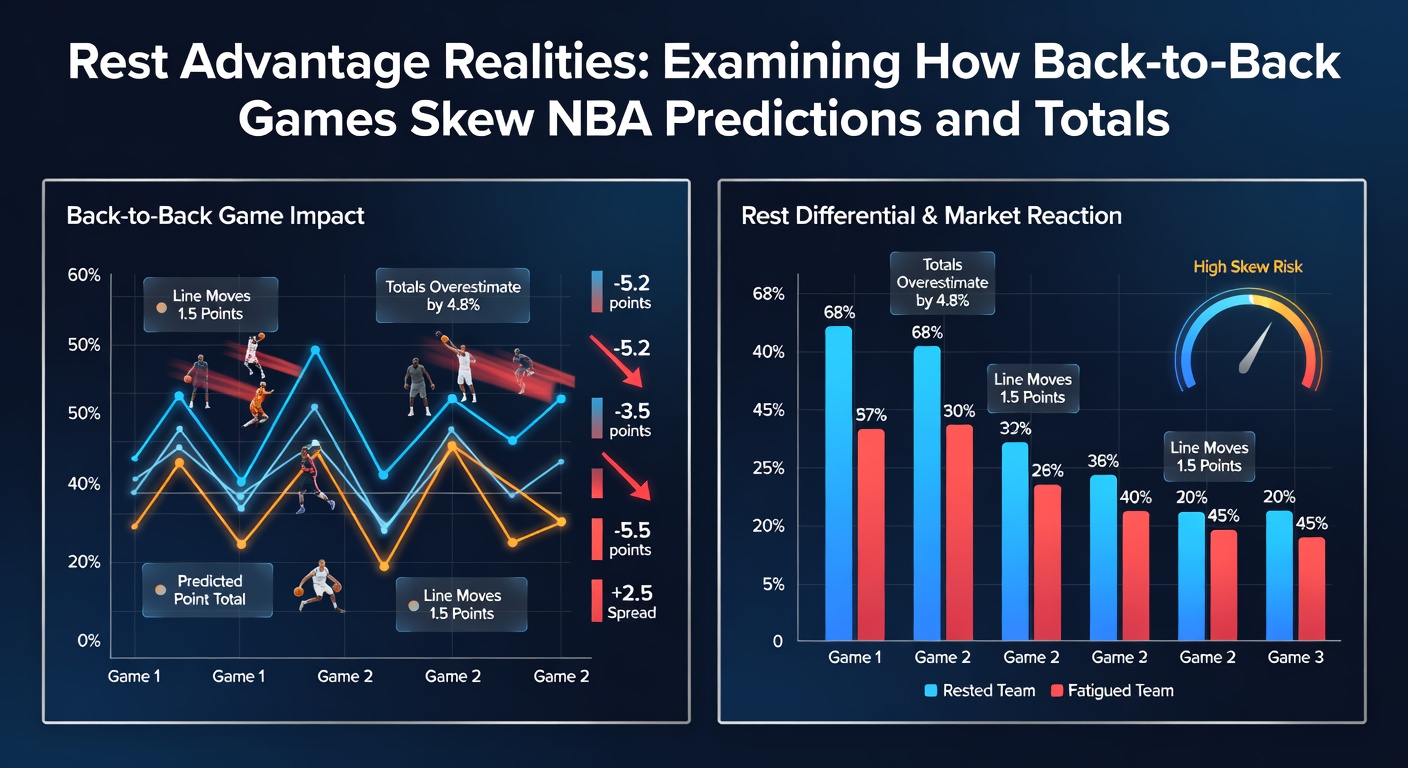
Researchers who have examined box scores across multiple seasons find that total points in games involving at least one back-to-back team trend lower than league averages, with the over hitting roughly 47 percent of the time compared to 51 percent when both sides enjoy normal rest. The effect compounds when both clubs arrive on short rest, because turnovers rise and pace slows as players conserve energy for defensive stands. Figures from the 2024-2025 campaign, for instance, revealed that games pitting two back-to-back teams produced combined scoring totals that landed under the posted number in 54 percent of instances according to aggregated play-by-play logs.
Travel distance adds another layer because cross-country flights the morning after a game leave little time for recovery, and teams arriving from the West Coast to play an East Coast opponent the next night post even steeper drops in three-point shooting accuracy. Studies tracking player-tracking data confirm that sprint speed and acceleration metrics decline measurably on the second night, which directly affects transition opportunities and fast-break points that normally inflate totals.
Impact on Predictive Models and Betting Lines
Prediction systems that incorporate rest as a variable adjust projected totals downward by four to six points when one side faces a back-to-back, and the adjustment grows larger if the opponent enjoys multiple days off. Bookmakers have incorporated these adjustments into their closing lines for years, yet sharp bettors continue to find value by comparing opening totals against rest-adjusted projections because public money often overlooks the fatigue factor in midweek games. The 2025-2026 schedule, which features the usual cluster of back-to-backs through March and April, sets up several stretches in May 2026 where playoff-bound teams must navigate consecutive games before the postseason begins.
One analysis of advanced metrics published by a Canadian sports analytics group showed that teams with superior depth maintain closer to their season-long efficiency on short rest, whereas shallower rosters experience larger drops in effective field-goal percentage. This distinction helps explain why certain franchises consistently outperform or underperform rest-based expectations year after year, and modelers who weight bench production alongside rest therefore produce more accurate totals forecasts.
Playoff and Late-Season Implications
During the 2025-2026 season, several clubs will enter May 2026 with heavy back-to-back loads behind them, and those who reach the playoffs often carry measurable residual fatigue into the first round. Historical playoff data indicates that teams playing on short rest in the regular season finale before a long layoff still post lower offensive ratings in their opening postseason contest compared to clubs that closed the schedule with multiple days off. Predictive models that ignore this carryover effect tend to overestimate totals in early playoff games involving the more fatigued side.
League-wide shifts toward load management have reduced some extreme back-to-back usage for star players, yet role players and second-unit members still log significant minutes on consecutive nights, and their diminished output influences overall game flow and pace. Data compiled by European basketball research organizations further supports the finding that international players who log heavy minutes during FIBA windows before returning to NBA back-to-back stretches show additional recovery deficits that compound the rest disadvantage.
Conclusion
Back-to-back scheduling continues to shape NBA outcomes in measurable ways that affect both win probabilities and point totals, and the patterns hold across regular-season and playoff contexts alike. Teams and analysts who integrate detailed rest tracking into their evaluations gain clearer pictures of expected scoring environments, while those who treat every game as equal risk missing the systematic edges that appear when one or both sides arrive on short rest. The realities of the modern schedule make these factors permanent considerations rather than occasional footnotes in any comprehensive approach to forecasting results.